Aesops Animals: Moral Truths vs. Scientific Reality

Introduction
In the shadow of a Greek courtyard, nearly two and a half millennia ago, a storyteller named Aesop—traditionally identified as a slave living between 620 and 564 BCE—began weaving narratives that would outlive empires [2]. These were not sprawling epics or complex tragedies, but lean, sharp-edged tales where the protagonist is rarely a man, but rather a fox, a lion, or a tortoise. These stories, now known as the Aesopica, do not merely entertain; they function as a moral architecture, using the natural world to map the intricacies of human ethics, social hierarchy, and political maneuvering [2].
While we often encounter these stories today as colorful bedtime reading for children, their history is far more sophisticated. Originally, the fables served as ethical guides for adults, navigating the dangerous waters of social and political life through the safe distance of metaphor [2]. Today, the “Aesopic” genre occupies a unique space in literature: it is part proverb, part aetiology, and part psychological mirror. Yet, as we look closer at the animals that inhabit these tales, a fascinating tension emerges between the moral truths they represent and the biological realities they supposedly depict.
The Architecture of the Fable
To understand the power of Aesop’s work, one must understand its structure. A fable is not merely a short story; it is a highly distilled literary form designed to deliver a specific cognitive payload. Most fables follow a consistent tripartite movement: a contextual introduction that sets the scene, a narrative driven by a conflict or a mistake, and a concluding moral that crystallizes the lesson [2].
The origins of these tales are a complex web of oral tradition. While the name Aesop remains the primary brand for this collection, modern scholars suggest that he was likely not the sole creator of every tale; rather, the name became a repository for any pithy, animal-driven moral tale lacking a known literary source [2]. This collection has deep roots in Greek tradition but shares significant DNA with West Asian and Indian traditions, such as the Panchatantra and the Buddhist Jataka tales [2].
The function of these stories has shifted dramatically across the centuries:
- Ancient Ethical Guidance: Used as tools for navigating social and political realities for adults [2].
- Aetiological Explanations: Serving to explain natural phenomena or animal characteristics, such as why certain creatures possess specific traits [2].
- Renaissance Pedagogy: Transforming into a foundational staple for the education and moral development of children [2].
Moral Truths vs. Scientific Reality
For centuries, the animals in Aesop’s fables have been treated as archetypes. The Fox is the cunning trickster; the Lion is the powerful sovereign; the Wolf is the predatory villain. However, recent inquiry has begun to bridge the gap between literary metaphor and biological fact. In Aesop’s Animals: The Science Behind the Fables, zoologist Jo Wimpenny interrogates whether these animal protagonists are based on observed scientific reality or are merely human-imposed stereotypes [1].
By applying modern ethology—the scientific study of animal behavior—to these ancient texts, we can see where Aesop’s “moral truth” aligns with nature and where it relies on anthropomorphism [1].
| Fable | The Moral/Literary Archetype | The Scientific Inquiry |
|---|---|---|
| The Crow and the Pitcher | The crow is depicted as an insightful, problem-solving genius [1]. | Tests the veracity of crow intelligence and their actual capacity for tool use [1]. |
| The Fox and the Crow | The fox is a master of deception and flattery [1]. | Investigates the actual social intelligence and predatory tactics of foxes [1]. |
| The Hare and the Tortoise | The hare represents arrogance/speed; the tortoise represents persistence [1]. | Analyzes animal behavior regarding speed versus future planning and energy conservation [1]. |
This tension highlights a fundamental aspect of the genre: the fable does not care about the biological accuracy of a wolf’s dietary habits, provided the wolf serves the purpose of illustrating the dangers of misplaced trust [1]. The “truth” of a fable is psychological, not zoological.
Understanding the Aesopic Corpus
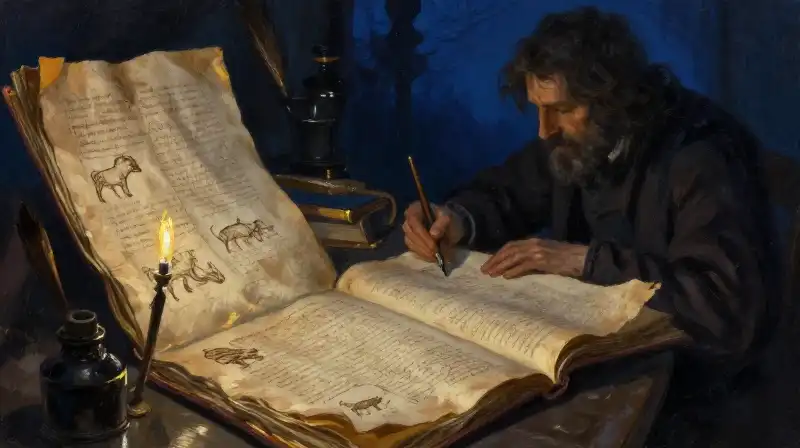
Because the fables have been transmitted through countless oral and written iterations—from Greek and Latin manuscripts to some of the earliest printed books in Europe—certain questions frequently arise for readers encountering this massive body of work [2].
Who were Aesop’s animals?
Aesop’s animals are not a specific biological list, but a collection of symbolic actors. They include a wide variety of creatures—from the “gnat” to the “lion”—that serve as proxies for human personality types [2, 3]. They are characters designed to perform specific roles in a moral drama, ranging from the industrious ant to the deceptive wolf [2, 3].
What is the animal in many of Aesop’s fables?
While many animals appear, certain figures recur due to their recognizable traits. The Fox is perhaps the most ubiquitous, often representing wit or cunning. Other frequent figures include the Lion (power), the Wolf (aggression), the Tortoise (persistence), and the Ant (diligence) [2, 3].
A Representative List of Fables
To grasp the breadth of the Aesopic tradition, one should look at the works that have defined the genre’s ability to distill complex human experiences into brief, memorable vignettes. The following are some of the most enduring titles maintained by literary historians and institutions like the Library of Congress [2, 3]:
- The Tortoise and the Hare: An exploration of the dangers of overconfidence and the value of steady, unrelenting effort [3].
- The Lion and the Mouse: A study in reciprocity, proving that no creature is too small to be of assistance to the powerful [3].
- The Wolf in Sheep’s Clothing: A cautionary tale regarding deception and the danger of accepting false appearances [3].
- The Fox and the Grapes: The origin of the term “sour grapes,” illustrating how humans rationalize their failures by disparaging what they cannot attain [3].
- The Goose that Laid the Golden Eggs: A warning against greed and the destruction of long-term stability for short-term gain [2, 3].
- The Ants and the Grasshopper: A narrative contrasting the virtues of preparation and foresight with the consequences of immediate gratification [2, 3].
Synthesis: Why Aesop Matters

The enduring relevance of Aesop lies in the economy of his craft. He mastered the art of the “extended proverb,” creating a narrative shorthand that allows a reader to grasp a complex ethical dilemma in a matter of paragraphs [2]. Whether we view these stories through the lens of ancient social politics, Renaissance education, or modern ethology, they remain vital because they address the constants of the human condition: greed, wit, pride, and perseverance.
By using animals as masks, Aesop allowed humanity to examine its own flaws without the immediate defensiveness that comes with direct critique. Even as modern science clarifies the reality of the animal kingdom, the “Aesopic” animal remains a permanent fixture in our cultural vocabulary—not because they are biologically accurate, but because they are psychologically true.
Sources
- Aesop’s Animals: The Science Behind the Fables: Jo Wimpenny: Bloomsbury Sigma - Bloomsbury — bloomsbury.com
- Aesop’s Fables — en.wikipedia.org
- Library of Congress Aesop Fables — read.gov
Frequently Asked Questions
Who were Aesop's animals?
Aesop's animals are a collection of symbolic actors that serve as proxies for human personality types. They range from the industrious ant to the deceptive wolf, acting as characters in moral dramas.
What is the animal in many of Aesop's fables?
While many animals appear, the fox is perhaps the most ubiquitous, representing wit or cunning. Other frequent figures include the lion, wolf, tortoise, and ant.
Related Articles