
What ScienceFiction Literatura novels feature galactic empire conflicts

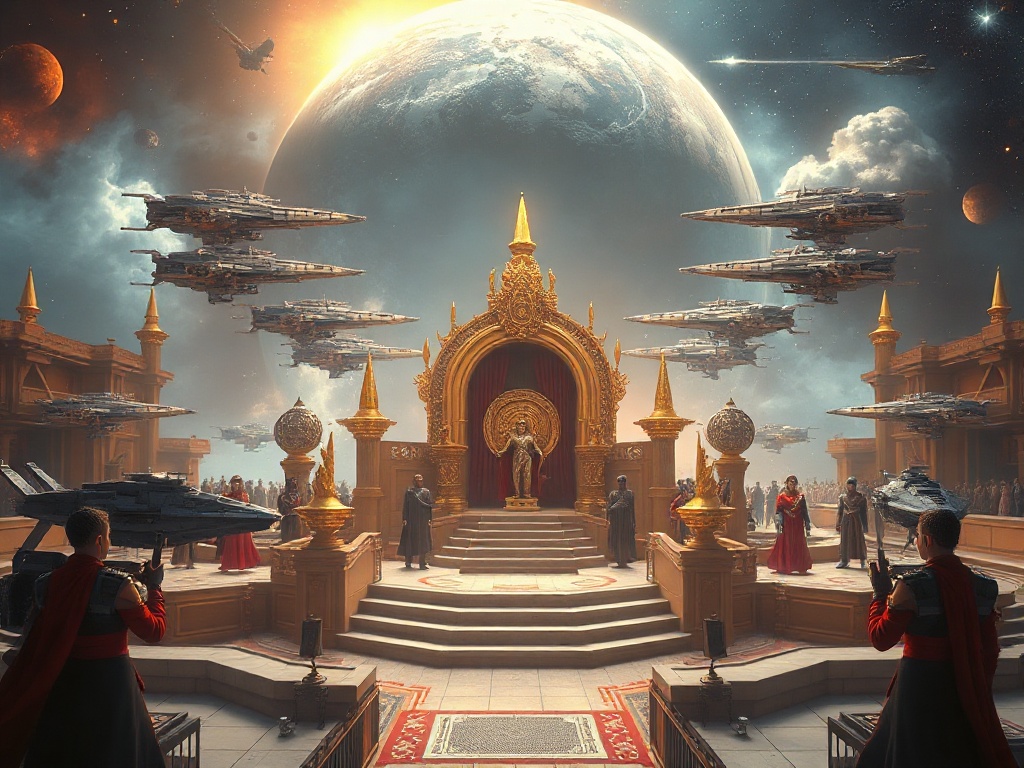
Science fiction, as a genre, frequently grapples with grand themes of power, governance, and the human condition. Among these, the concept of a galactic empire – a vast, often oppressive, political entity spanning multiple star systems – has proven particularly fertile ground for compelling narratives. These narratives explore the complexities of ruling over diverse populations, the challenges of maintaining order across interstellar distances, and the inevitable rebellions that arise when freedom is stifled. The appeal lies in their ability to extrapolate current political and social anxieties onto a cosmic scale.
The depiction of galactic empires isn’t monolithic. While some portrayals focus on the sheer scope and technological prowess of the rulers, others delve into the moral ambiguities of colonialism and the human cost of expansion. Examining these different portrayals through literature offers a unique lens through which to understand our own histories and consider potential futures. This article will explore several notable examples of science fiction literature that feature such conflicts, analyzing the nuances of their empires and the struggles against them.
## Dune and the Imperium of House Harkonnen and House Atreides
Frank Herbert’s Dune presents a complex feudal society masked under the veneer of a galactic empire. While the Padishah Emperor holds nominal power, true control resides in the hands of powerful Great Houses, vying for influence and resources across the known universe. The central conflict revolves around the control of Arrakis, a desert planet that is the sole source of “spice,” a vital substance for interstellar travel and extending life. The brutal campaigns and shifting allegiances between House Harkonnen and House Atreides encapsulate the inherent instability and ruthless competition within this vast imperial structure.
The story meticulously explores the ecological and social consequences of imperial exploitation. The Fremen, native inhabitants of Arrakis, are subjected to centuries of oppression by the imperial powers, leading to a simmering resentment that ultimately explodes into a full-blown rebellion. Herbert uses this conflict to critique resource extraction and the damaging effects of unchecked power, highlighting the fragility of even the most seemingly dominant empires when confronted with indigenous resistance. Furthermore, the Bene Gesserit sisterhood, with their subtle manipulations and long-term planning, demonstrates another, less overt, form of imperial influence.
Finally, Dune’s depiction avoids a simplistic good versus evil narrative. Even the seemingly villainous House Harkonnen operates within a system that incentivizes ruthlessness and exploitation. The novel ultimately suggests that the true danger lies not in any single house, but in the inherent flaws of the imperial system itself – its dependence on finite resources and its tendency towards oppression. This nuanced portrayal distinguishes it from more straightforward depictions of galactic empires.
## Foundation and the Fall of the Galactic Empire
Isaac Asimov’s Foundation series offers a different perspective, focusing on the decline and eventual rebirth of a sprawling galactic empire. The Trantorian Empire, spanning countless worlds and centuries, is facing inevitable collapse as predicted by Hari Seldon and his science of psychohistory, a fictional predictive social science. Seldon’s plan to shorten the coming dark age and guide humanity towards a new era of progress forms the core of the narrative.
The series avoids portraying direct, violent rebellion against the Empire (initially). Instead, it focuses on the slow, inexorable process of its disintegration, with political maneuvering, economic instability, and regional separatism chipping away at its power. The psychohistory itself becomes a tool for managing the decline, mitigating the worst effects of the coming chaos. Asimov emphasizes the impersonal forces of history and the challenges of predicting and influencing societal trends, even with advanced technology.
Ultimately, Foundation uses the decline of the Empire to explore the themes of resilience and the cyclical nature of history. While the Empire’s fall is inevitable, Seldon’s Foundation ensures that knowledge and civilization are preserved, paving the way for a new, potentially better, galactic order. The focus isn’t on overthrowing a tyrannical ruler, but on navigating the complexities of societal change and adapting to an uncertain future.
## A Fire Upon the Deep and the Lord of the Vast
Vernor Vinge’s A Fire Upon the Deep presents a truly terrifying vision of a galactic empire defined by the existence of Zones of Thought, areas of space where different levels of technology and intelligence are possible. The Lord of the Vast, an ancient and incredibly powerful being imprisoned in the Beyond, represents the ultimate threat to the galaxy, and its escape triggers a cascade of events that plunge the galaxy into chaos.
The depiction of the Blight, the Lord of the Vast’s creations, demonstrates the devastating consequences of unchecked power and advanced, incomprehensible technology. They consume entire worlds and civilizations, leaving nothing but devastation in their wake. The scattered human colonies, connected through ancient, largely forgotten systems of communication and technology, find themselves in a desperate struggle for survival, forced to rely on unlikely alliances and rediscover lost knowledge. The sheer scale of the danger and the advanced nature of the antagonist elevates this beyond a simple rebellion narrative.
The novel’s genius lies in its exploration of the boundaries of intelligence and the dangers of tampering with forces beyond human understanding. The ancient civilizations that constructed the Zones of Thought clearly underestimated the potential consequences, leading to the current crisis. A Fire Upon the Deep offers a cautionary tale about the hubris of technological advancement and the importance of respecting the limits of knowledge.
## The Expanse and the Martian Congressional Republic and Earth
While The Expanse doesn’t strictly feature a monolithic galactic empire, the power dynamic between the Martian Congressional Republic (MCR), Earth (United Nations), and the Outer Planets Alliance (OPA) creates a complex web of political rivalry and simmering conflict that mimics many aspects of imperial systems. The MCR, with its advanced technology and strong military, acts as a significant power, often imposing its will on the resource-rich outer planets.
The series highlights the tensions and injustices inherent in a system where resource wealth is unevenly distributed. The Outer Planets, particularly Ceres and the Belt, are exploited for their minerals, leading to widespread poverty and resentment among the “Belters.” This fuels the OPA’s rebellion, a fractured and often violent movement seeking autonomy and fair treatment. The constant threat of war and the precarious balance of power define the political landscape.
The series avoids simplistic portrayals of good and evil, demonstrating the flaws and complexities of each faction. Earth is portrayed as a decaying, bureaucratic superpower, while Mars embodies a rigid, efficiency-driven society with its own set of biases. The protagonists, often caught between these factions, struggle to navigate a morally ambiguous landscape, highlighting the human cost of interstellar conflict. The Expanse’s grounded approach and focus on the social and political realities of space exploration make it a compelling and nuanced portrayal of power dynamics in a multi-planetary system.
Conclusion
The science fiction novels discussed demonstrate the enduring appeal of exploring galactic empire conflicts. From the feudal complexities of Dune to the societal collapse in Foundation, the looming threat of the Lord of the Vast in A Fire Upon the Deep, and the power struggles of The Expanse, these works offer diverse perspectives on the nature of power, oppression, and the pursuit of freedom. Each story utilizes the framework of a galactic empire – or a proxy for one – to delve into profound questions about humanity’s capacity for both destruction and resilience.
Ultimately, these literary explorations of galactic empire conflicts serve as allegories for our own world, prompting reflection on the dangers of unchecked power, the importance of social justice, and the enduring human spirit in the face of adversity. By projecting these themes onto a cosmic scale, science fiction allows us to confront uncomfortable truths about ourselves and our societies, offering both cautionary tales and glimpses of potential futures where a more equitable and sustainable galactic order might be possible. The exploration of these themes will undoubtedly continue to captivate readers for generations to come.
Related Articles