
Great Dystopian Novels: From Orwell to Atwood and Beyond

Introduction
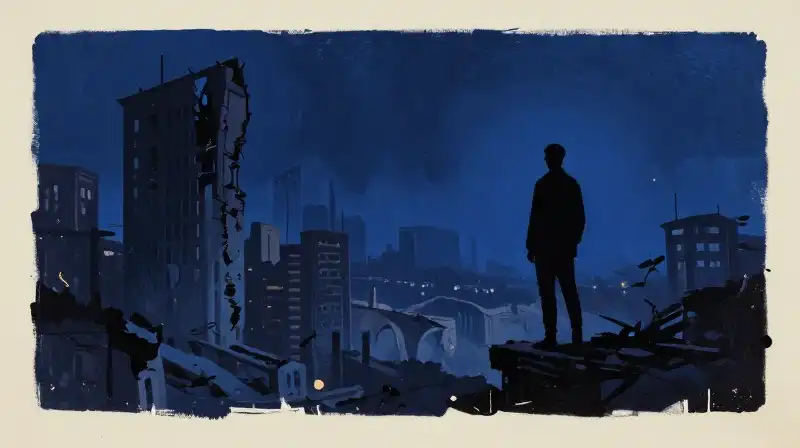
A heavy, grey sky hangs over a world where the written word is a crime, or perhaps a world where the very concept of individual thought has been surgically removed by a state that governs through pleasure rather than pain. These are the two poles of the dystopian imagination. Dystopian fiction does not merely attempt to frighten; it serves as a dark mirror to our own reality, magnifying the cracks in our social, political, and technological foundations to show us a version of ourselves that has gone catastrophically wrong [2]. It is a genre of warning, using the “what if” of a nightmare to demand a more vigilant “what is” in the present.
While often grouped with other speculative genres, true dystopia relies on a specific tension: the presence of an organized, functioning, yet profoundly oppressive societal structure. This distinguishes it from the raw, lawless chaos of the post-apocalypse. To understand the great dystopian novels is to understand the varying ways humanity can lose its soul—whether through the iron fist of a dictator, the soft velvet of consumerism, or the silent erosion of memory and empathy.
Defining the Genre: Dystopia vs. Post-Apocalypse
For many readers, the line between a world ending and a world gone wrong is thin, but for literary analysis, the distinction is vital. Understanding this nuance helps in navigating a library of speculative fiction.
| Feature | Dystopian Fiction | Post-Apocalyptic Fiction |
|---|---|---|
| Core Focus | The mechanisms of social control and the loss of individual agency within a functioning (albeit broken) system. | The struggle for survival in the immediate or long-term aftermath of a total societal collapse. |
| The “Enemy” | The State, a corporation, or a rigid social hierarchy. | Nature, scarcity, starvation, or the elements. |
| Key Example | 1984 (State surveillance and thought control). | The Road by Cormac McCarthy (Survival in a dead landscape) [1]. |
While some works, such as Emily St. John Mandel’s Station Eleven, may inhabit the intersection of both—exploring how society reconstructs itself after a pandemic—the genre’s primary engine is the examination of how power operates [2].
The Pillars of Dystopian Literature
To study the genre is to encounter a lineage of authors who transitioned from predicting political tyranny to predicting technological and psychological erosion. These works are often considered the “classics” that provide the blueprint for everything that followed.
The Architecture of Control: Orwell and Huxley
The two most significant benchmarks of the genre offer opposing visions of how humanity might be subjugated. George Orwell’s 1984 remains the definitive study of overt state oppression, focusing on surveillance, the manipulation of language (Newspeak), and the crushing of the human spirit through fear [1]. In contrast, Aldous Huxley’s Brave New World is often viewed as more prophetic for the modern era [1]. Rather than using pain and the “boot stamping on a human face,” Huxley’s dystopia utilizes pleasure, biological engineering, and endless distraction to ensure citizens never desire freedom in the first place.
The Erasure of Identity and Memory
Beyond the grand political stage, some of the most haunting dystopian works focus on the intimate loss of the self. These novels explore how societies maintain “order” by stripping away the very things that make us human.
- Lois Lowry, The Giver: A profound study of a “utopian” society that achieves peace only by suppressing all emotion, color, and human expression, effectively lobotomizing the collective experience to prevent conflict [1].
- Yoko Ogawa, The Memory Police: A significant exploration of how the disappearance of objects—and the memories associated with them—erodes the essence of existence [1].
- Kazuo Ishiguro, Never Let Me Go: A devastating look at the ethics of medical advancement, questioning whether clones possess individual agency or are merely tools for a stable society [1].
Technology and the Automated Future
As our reliance on algorithms and automation grows, the genre has turned its gaze toward the silicon brain. The fear is no longer just about a dictator, but about a system that functions too efficiently for human benefit.
- Kurt Vonnegut, Player Piano: Written in 1952, this novel is strikingly prescient in its depiction of how automation and advanced technology can lead to social decline and the displacement of human purpose [1].
- Richard Condick, Colossus: A seminal work that influenced the concept of the rogue AI (the “Skynet” archetype) and remains a vital touchstone for discussions on artificial intelligence [1].
- Philip K. Dick, Do Androids Dream of Electric Sheep?: A foundational science fiction text that asks what defines “humanity” in a world where the biological and the synthetic are indistinguishable [1].
What Dystopian Book Should I Read First?
If you are new to the genre, the “best” starting point depends on which type of dread you find most compelling. We suggest a tiered approach based on your interests:
- For Political Insight: Start with 1984. It provides the essential vocabulary for understanding modern discussions around surveillance and propaganda.
- For Social Commentary: Choose The Handmaid’s Tale by Margaret Atwood. It is a visceral, terrifyingly relevant exploration of misogyny and the fragility of women’s rights [2].
- For Philosophical Inquiry: Try Brave New World. It will challenge you to consider whether a “happy” society is worth the loss of suffering—and truth.
- For Modern Pacing: Look toward The Hunger Games or Snow Crash. While differing in depth from the classics, they offer a high-octane entry point into how these themes manifest in contemporary narrative structures [1].
The Evolution of the Genre: From Warning to Reality
Modern dystopian fiction has shifted. While the classics often dealt with the “Big Brother” of the state, contemporary works like Neal Stephenson’s Snow Crash represent the type of hyper-mediated, fragmented future that feels increasingly close to our current reality of digital corporatocracy [1]. We are moving from a fear of being controlled by a single entity to a fear of being lost in a sea of data, distraction, and simulated reality.
The enduring power of these novels lies in their ability to remain uncomfortable. A truly great dystopian novel does not end with a neat resolution; it ends by leaving the reader looking at their own smartphone, their own government, or their own neighbor with a newfound, trembling scrutiny. They matter because they remind us that the structures we inhabit are not natural laws, but choices—and that once certain choices are made, they may be impossible to undo.
Sources
- What is the best dystopian book of all time in your opinion? (Aka which one is your favourite?) : r/booksuggestions — reddit.com
- 30 of the best dystopian novels of all time — panmacmillan.com
Frequently Asked Questions
What dystopian book should I read first?
The best starting point depends on your interests, such as starting with 1984 for political insight or The Handmaid’s Tale for social commentary. For philosophical inquiry, Brave New World is recommended, while The Hunger Games or Snow Crash offer modern pacing.
What dystopian books are now considered classics?
The article identifies George Orwell’s 1984 and Aldous Huxley’s Brave New World as significant benchmarks and classics of the genre. Other works mentioned in the context of foundational or classic studies include works by Lois Lowry, Yoko Ogawa, and Kazuo Ishiguro.
Related Articles