
Postmodern Fiction Books: A Guide to Essential Authors and Works

Introduction
To read a postmodern novel is often to feel the floorboards of reality shifting beneath your feet. Unlike the traditional realist novel, which seeks to hold a mirror up to nature and provide a stable, coherent window into a recognizable world, postmodern fiction intentionally cracks that mirror. It operates on the suspicion that there is no single, objective “truth” waiting to be discovered, but rather a series of competing narratives, linguistic constructs, and fragmented perspectives.
Postmodernism as a school of thought involves the breakdown of traditional categories and a deep questioning of narrative as a reliable vehicle for truth [1]. It suggests that language itself may act as a barrier, preventing us from accessing a “real” world outside of the symbols we use to describe it [1]. For the reader, this can be both exhilarating and disorienting. It transforms the act of reading from a passive reception of a story into an active, often dizzying, engagement with the very mechanics of how stories are built.
The Mechanics of Postmodernism
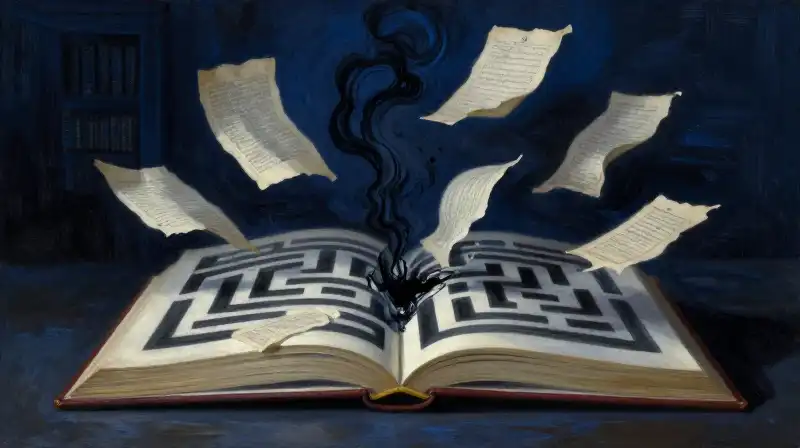
Postmodernism is not merely a “difficult” style; it is a specific aesthetic and philosophical approach characterized by several key techniques. Understanding these hallmarks can help demystify works that might otherwise seem impenetrable.
- Metafiction: This is fiction that is self-aware. The narrative frequently draws attention to its own status as an artifact, often breaking the “fourth wall” to remind the reader they are consuming a constructed story. A classic example is Tom Stoppard’s play Rosencrantz and Guildenstern Are Dead, which takes two minor characters from Hamlet and forces them to navigate a world where they are aware of their roles in a pre-existing script [1].
- Pastiche: Rather than creating entirely “new” forms, postmodern writers often engage in pastiche—the imitation or blending of various styles, genres, and historical periods [1]. This creates a sense of “genre-mashing” that challenges the idea of literary purity.
- Fragmentation: Postmodern narratives often reject linear, chronological progression in favor of disjointed structures. These works may weave various disparate threads together, requiring the reader to participate in constructing a new, explanatory whole from the shards [1].
- Intertextuality: The genre frequently relies on the relationship between texts, referencing, parodying, or rewriting older works to show how all literature exists in a constant dialogue with what came before.
A Guide to Essential Authors and Works
Because the genre ranges from accessible mysteries to dense, “obfuscating” prose, the best way to approach postmodern fiction is to find an entry point that matches your preferred level of complexity.
Accessible Entry Points
If you are wary of the reputation for being intentionally confusing, these works offer postmodern themes through more traditional narrative frameworks.
- Umberto Eco: Eco is a master of blending medievalism with postmodern sensibilities, merging ancient ideas with modern structures [1]. The Name of the Rose is an ideal starting point; while it explores deep philosophical questions, it maintains the recognizable structure of a “Sherlock Holmes” style murder mystery [1].
- Don DeLillo: White Noise is frequently cited as one of the more accessible postmodern works, using a relatively straightforward narrative to explore themes of consumerism, technology, and the mediation of reality [1].
- Kurt Vonnegut: Breakfast of Champions uses satire and a highly stylized, almost cartoonish prose to critique modern society, making complex ideas digestible through dark humor [1].
Intermediate Complexity and Genre-Bending
Once you are comfortable with the idea of shifting perspectives and non-linear timelines, these works push the boundaries further.
- David Mitchell: Cloud Atlas acts as a “literary genre-masher,” utilizing multiple, distinct genres to construct its overarching narrative, moving from historical fiction to dystopian sci-fi [1].
- Paul Auster: A key figure for the genre, Auster’s work—such as The New York Trilogy or The Book of Illusions—often plays with the detective genre to explore themes of identity and the instability of truth [1].
- Haruki Murakami: The Wind-up Bird Chronicle blends elements of magical realism and surrealism, creating a dreamlike, fragmented experience that is quintessential to contemporary postmodernism [1].
Advanced and Experimental Works
For readers seeking a profound challenge in prose and structure, these authors represent the “deep end” of the genre.
- Thomas Pynchon and James Joyce: These authors are often cited as more difficult than Eco due to their complex, often “obfuscating” prose and dense layers of allusion [1]. Pynchon’s The Crying of Lot 49 is a hallmark of the era’s paranoia and linguistic play.
- Mark Danielewski: House of Leaves is a significant work for those interested in the intersection of postmodernism and horror, utilizing experimental typography and layout to mirror the psychological disintegration of its characters [1].
- Jorge Luis Borges: Often described as a “bridge between modernism and postmodernism,” Borges’s Collected Fictions uses short, labyrinthine stories to explore the infinite and the illusory nature of reality [1].
Comparing Literary Approaches
To better understand where postmodernism sits in the literary landscape, it helps to contrast it with the movements that preceded it.
| Feature | Realism | Modernism | Postmodernism |
|---|---|---|---|
| View of Truth | Objective and discoverable through observation. | Subjective; truth is found through internal psychological depth. | Fragmented; truth is a social or linguistic construct. |
| Narrative Structure | Linear and chronological. | Non-linear, but often seeking a unified meaning. | Disjointed, playful, and often rejecting a unified whole. |
| Authorial Stance | The invisible “omniscient” narrator. | The self-conscious, searching artist. | The meta-fictional participant or “pasticheur.” |
Frequently Asked Questions
What are three novels that are considered postmodern fiction?
Three highly representative examples are Don DeLillo’s White Noise, which explores the saturation of media and consumerism; Umberto Eco’s The Name of the Rose, which blends historical mystery with philosophical inquiry; and Thomas Pynchon’s The Crying of Lot 49, which is celebrated for its complex, paranoid exploration of meaning [1].
Who are the most famous postmodern authors?
The canon of postmodern literature includes a diverse array of voices such as Thomas Pynchon, Don DeLillo, Kurt Vonnegut, Paul Auster, and Jorge Luis Borges [1]. These authors are recognized for their ability to challenge the conventions of storytelling and the stability of language.
Why Postmodernism Matters
Postmodernism is often criticized for being “difficult” or “meaningless,” but its value lies in its refusal to offer easy answers. By breaking down the traditional structures of the novel, postmodern authors force us to confront the ways in which our understanding of the world is mediated by language, media, and culture. It is a literature of interrogation—interrogating the text, the author, and the reader’s own assumptions about what is “real.” Whether through the playful genre-mashing of David Mitchell or the labyrinthine puzzles of Borges, postmodernism remains a vital tool for exploring the complexities of a world that feels increasingly fragmented and constructed.
Sources
- Best Postmodern Literature? : r/books — reddit.com
Frequently Asked Questions
What are three novels that are considered postmodern fiction?
Three representative examples include Don DeLillo's White Noise, Umberto Eco's The Name of the Rose, and Thomas Pynchon's The Crying of Lot 49.
Who are the most famous postmodern authors?
The postmodern canon includes diverse voices such as Thomas Pynchon, Don DeLillo, Kurt Vonnegut, Paul Auster, and Jorge Luis Borges.
Related Articles