
The Story of an Hour: A Deep Dive into Chopins Literary Elements


The Architecture of a Moment

Kate Chopin’s “The Story of an Hour” is a masterclass in economy. In a text that spans barely two pages, Chopin manages to dismantle the traditional boundaries of domesticity, identity, and autonomy. For the reader, the impact of the story lies not in its length, but in its structural precision. It is a narrative that functions like a coiled spring; every sentence is weighted, every setting is deliberate, and every character beat serves a larger, often subversive, architectural purpose.
To understand the literary elements of “The Story of an Hour,” one must look past the surface-level shock of its ending and examine how Chopin utilizes plot, perspective, and sensory imagery to create a profound psychological transformation. The story does not merely tell us that a woman finds freedom; it constructs a physical and emotional space where that freedom becomes an inevitability before it is tragically revoked.
A Three-Act Structure in Two Pages
One of the most remarkable aspects of the work is its ability to contain a complete dramatic arc within a minute timeframe. Despite its brevity, the story follows a rigorous three-act structure that mirrors the traditional pacing of a much longer novel [1].
Act I: The Inciting Incident and the Established Problem
The narrative begins with a clinical, distant observation of a crisis: Mrs. Mallard’s heart condition. This is more than a medical detail; it establishes the central “problem” or tension of the story. The news of her husband’s death in a train accident must be delivered with extreme caution, setting a tone of fragility and impending upheaval [1]. In this opening act, the narrative voice is omniscient and detached, observing the social ritual of delivering bad news to a grieving wife.
Act II: The Internal Pivot and Midpoint
The story shifts significantly when Louise Mallard retreats to her upstairs bedroom. This physical movement from the communal downstairs parlor to the private upstairs bedroom signals a shift in narrative perspective [1]. As she sits alone, the voice moves closer to her internal consciousness. The midpoint of the story occurs during this solitary confinement, marked by her whispered realization: “Free! Body and soul free!” This is the pivot where the story transforms from a tragedy of loss into a revelation of selfhood [1].
Act III: The Descent and the Climax
The final act begins with Louise’s descent from her room. She moves “unwittingly like a goddess of Victory,” a description that elevates her from a victim of circumstance to a woman reclaimed by her own agency [1]. The climax, however, is unique because it occurs “off the page.” Chopin does not describe the moment of death; instead, she uses the sudden return of Brently Mallard to trigger a physiological and emotional collapse that the reader must infer [1].
Key Literary Devices and Techniques
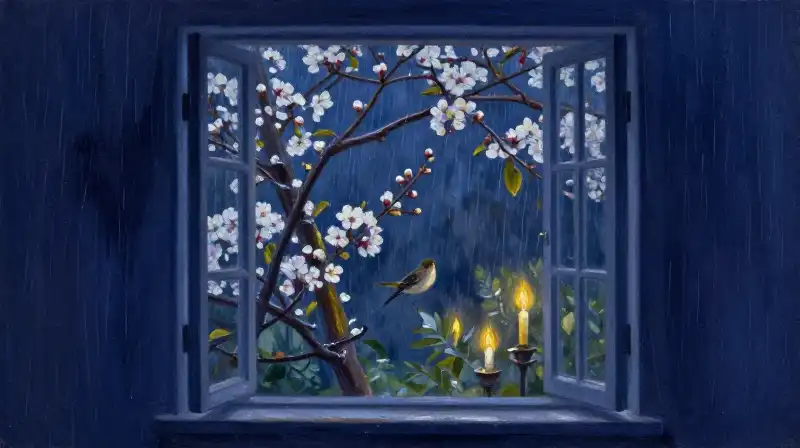
Readers often ask: What literary devices did Kate Chopin use? The effectiveness of the story relies on a specific toolkit of imagery, irony, and symbolism that works in concert to reinforce the theme of suppressed autonomy.
- Sensory Imagery: In the second act, Chopin uses the natural world to mirror Louise’s internal awakening. Descriptions of “new spring life,” the “delicious breath of rain,” and “countless sparrows… twittering in the eaves” create an atmosphere of rebirth and anticipation [1]. This sensory immersion helps the reader feel the vitality of the world that Louise is suddenly eager to inhabit.
- The Rule of Three: Chopin employs structural repetition through the character of Josephine. By having Josephine knock on the door three times with increasing intensity, Chopin builds tension and emphasizes the boundary between the social world demanding Louise’s grief and the private world where Louise is finding herself [1].
- Symbolism of Setting: The physical movement of the characters acts as a symbol for their psychological states. The “downstairs” represents the social expectations of marriage and widowhood, while the “upstairs” bedroom represents the private, unobserved sanctuary of the soul [1].
- Dramatic Irony: The final line of the story—that she died of “the joy that kills”—is perhaps one of the most famous examples of irony in American literature. The characters in the story (and the medical diagnosis) assume she died of overwhelming happiness at seeing her husband alive; the reader, however, understands the irony is that she likely died from the sudden, crushing loss of the freedom she had just tasted [1].
The Fluidity of Identity and Perspective
Characterization in “The Story of an Hour” is inextricably linked to the narrative’s shifting perspective. At the start, the protagonist is defined primarily by her relationship to others. She is introduced as “Mrs. Mallard,” a label that ties her identity to her husband [1]. As the story progresses and she enters her moment of clarity, she is identified by her first name, Louise, suggesting a reclamation of her individual self [1]. Yet, by the story’s end, as the social order is restored, she reverts to being identified simply as “his wife” [1].
There is also a layer of ambiguity found in the supporting characters, specifically Richards. His role in delivering the news and his attempt to “screen [Brently] from the view of his wife” introduces questions about his motives and the degree to which the male characters in the story attempt to manage or manipulate the female experience [1].
Why It Matters

The enduring power of “The Story of an Hour” lies in its refusal to provide easy answers. By utilizing a tight, three-act structure and a shifting narrative voice, Chopin forces the reader to experience the dizzying transition from grief to liberation, and finally, to total disillusionment. The ambiguity of the ending—whether Louise died of shock, grief, or the sheer desperation of a stolen future—ensures that the story remains a subject of debate. It is a profound exploration of how the structures of society can clash with the fundamental needs of the individual, making it a cornerstone of literary realism and feminist critique.
Sources
- Three-Act Analysis of “The Story of an Hour” by Kate Chopin — diymfa.com
Frequently Asked Questions
What literary devices did Kate Chopin use?
Kate Chopin utilizes a toolkit of sensory imagery, irony, and symbolism to reinforce the theme of suppressed autonomy. Specifically, she employs sensory imagery of the natural world, the structural repetition of the rule of three, symbolism of setting, and dramatic irony.
Related Articles