Classic Mystery Books: From Poe to Christie and the Noir Masters

Introduction
The modern obsession with the “whodunit” begins not with a sprawling police procedural, but with a single, chilling realization: that a crime can be a puzzle solvable by the sheer force of logic. Before the genre became a staple of television and cinematic thrillers, it was an experimental playground for authors testing the limits of deduction, atmosphere, and the reliability of human perception. To trace the lineage of the classic mystery is to watch a genre evolve from the cerebral, almost mathematical exercises of the mid-19th century into the gritty, rain-slicked streets of mid-century noir, and finally into the psychological labyrinth of the modern era.
The Architect of Deduction: Edgar Allan Poe

The genre owes its very existence to Edgar Allan Poe, who is credited with having “literally invented the modern detective genre” [1]. Poe did not merely write stories about crime; he established the structural blueprint that writers still follow today. Through his seminal works, such as The Murders in the Rue Morgue (1841), The Mystery of Marie Rogêt, and The Purloined Letter, Poe introduced the concept of the hyper-rational investigator who uses ratiocination—a process of intense logical deduction—to see what others overlook [1].
Poe’s contribution was more than just a character type; it was a shift in narrative focus. The mystery was no longer just about the act of violence, but about the intellectual triumph over chaos. By centering the narrative on the detective’s mind, Poe turned the reader into a silent partner in the investigation, a tradition that remains the heartbeat of the genre.
The Golden Age: Intricacy and the “Locked Room”
As the mystery genre matured, it entered what is often termed the “Golden Age,” a period defined by highly structured plots, social settings, and the elevation of the “puzzle” to an art form. This era saw a divergence in style, from the cozy, intellectual challenges of English manor houses to the more expansive, character-driven novels of the early 20th century.
The Precursor: Wilkie Collins
Before the Golden Age reached its zenith, Wilkie Collins laid the groundwork for the English tradition. His novel The Moonstone is frequently cited by T. S. Eliot as “the first, the longest, and the best of modern English detective novels” [2]. Collins moved away from the purely clinical deduction of Poe, introducing a more complex tapestry of memory and unreliable testimony, where the very facts of a case could prove treacherous to the investigator [2].
The Queen of Mystery: Agatha Christie
No discussion of classic mystery books is complete without Agatha Christie. Often referred to as the “Queen of Mystery,” Christie mastered the ability to blend ingenious plotting with recognizable human archetypes [1]. Her work provides multiple entry points for the reader, depending on whether they prefer the methodical, psychological precision of Hercule Poirot or the intuitive, observational skills of Miss Marple [1, 2]. Her standalone masterpieces, such as And Then There Were None, Murder on the Orient Express, and The Murder of Roger Ackroyd, remain benchmarks for how to manipulate reader expectations through structural subversion [1, 2].
The Craft of the Impossible: Specialized Techniques
During this era, specific literary techniques became hallmarks of the genre, allowing authors to push the boundaries of what seemed physically possible within a narrative.
- The Locked Room Mystery: A trope where a crime is committed in a location that appears impossible to enter or exit. John Dickson Carr became the undisputed “master of the ‘locked room’ mystery and impossible crimes” [1]. In works like The Three Coffins, he creates scenarios where a victim is found dead in a sealed room with no sign of a weapon or an intruder, even when surrounding elements, like snow-covered windows, remain undisturbed [2].
- The Challenge to the Reader: A meta-fictional technique used to engage the audience directly. Ellery Queen was notable for utilizing a “Challenge to the Reader,” a formal declaration in which the author claims that every clue necessary to solve the crime has been presented to the reader at the same time it was presented to the detective [1].
The Hardboiled Shift: Noir and the Urban Detective
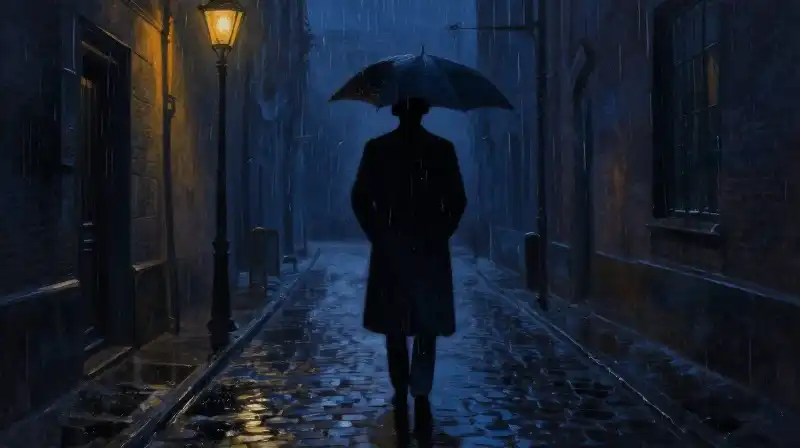
By the 1930s and 40s, the genre underwent a seismic shift. The polite, drawing-room mysteries of the English tradition were supplanted by the “hardboiled” and “noir” styles, which traded social etiquette for urban grit, moral ambiguity, and visceral realism.
| Feature | Golden Age / Cozy Mystery | Hardboiled / Noir |
|---|---|---|
| Setting | Manor houses, small villages, closed circles | Urban centers, dark alleys, corrupt cities |
| Detective Persona | Intellectual, often an amateur or gentleman | World-weary, often a professional private eye |
| Primary Conflict | Solving a logical puzzle | Navigating moral decay and personal survival |
| Tone | Orderly, restorative, often lighthearted | Cynical, violent, and fatalistic |
Masters of the Shadows
The noir subgenre found its voice through authors who understood the darker impulses of the human psyche. Raymond Chandler’s The Big Sleep (1939) introduced Philip Marlowe, the “quintessential urban private eye,” a figure who operates in a world where the line between law and crime is perpetually blurred [1, 2]. Dashiell Hammett, who brought a sense of lived-in realism to the genre through his own experience as a private detective, crafted visceral works like Red Harvest [1, 2].
While Chandler and Hammett focused on the detective, other authors explored the darker edges of the criminal experience. James M. Cain’s The Postman Always Rings Twice (1934) became a landmark for its “explosive mixture of violence and eroticism” [2], while Cornell Woolrich’s Waltz into Darkness became a classic of the “femme fatale” narrative, a staple of noir storytelling [2].
Modernity and Psychological Depth
As the genre moved into the late 20th century, the focus shifted again—this time toward psychological complexity and forensic accuracy. Authors like P.D. James moved away from the “puzzle” for puzzles’ sake, instead using the mystery to explore the profound depths of the human condition. Her protagonist, Adam Dalgliesh, is not merely a detective but a London-based Police Commander and a poet, navigating settings that range from high-tech forensic laboratories to the isolation of remote monasteries [1]. This evolution reflects a broader literary trend: the marriage of the procedural “how” with the psychological “why.”
A Guide to Navigating the Genre
For readers looking to explore these classic mystery books, the best approach depends on what kind of intellectual engagement you seek. If you are a beginner, consider these starting paths:
- For the Pure Logic Enthusiast: Start with Edgar Allan Poe to understand the mechanics of deduction, then move to Agatha Christie to see how those mechanics are scaled into complex narratives.
- For the Atmosphere Seeker: Begin with the Gothic suspense of Mary Roberts Rinehart’s The Circular Staircase or the Jack the Ripper-inspired tension of Marie Belloc-Lowndes’s The Lodger [2].
- For the Realism Seeker: Dive straight into the hardboiled era with Dashiell Hammett or Raymond Chandler to experience the genre’s grit and social commentary.
Synthesis: Why the Mystery Matters
The enduring appeal of the classic mystery lies in its ability to provide a sense of closure in an inherently chaotic world. Whether it is the mathematical certainty of a Poe deduction, the intricate clockwork of a Christie plot, or the somber reflections of a Dalgliesh investigation, the genre offers a structured way to confront the darkest aspects of humanity. It is a genre that rewards attention, demands empathy, and ultimately asserts that even in the face of profound disorder, there is a logic—however difficult to find—that can bring the truth to light.
Sources
- Huge mystery fan here, suggest me classic mystery novels. : r/suggestmeabook — reddit.com
- Favorite Mystery Classics - Bookshop.org — bookshop.org
Related Articles